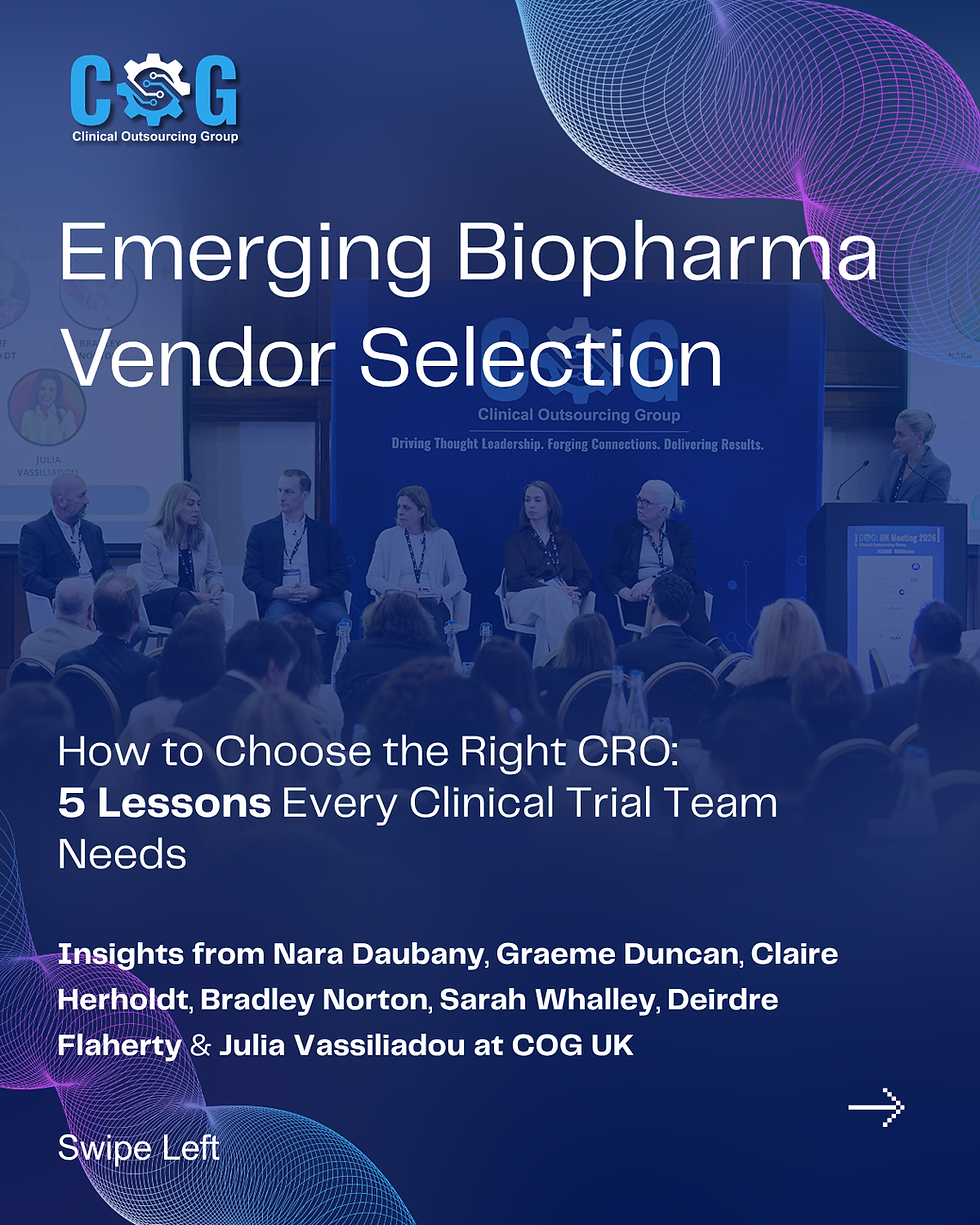
Flexibility by Design: Rethinking hybrid models for today’s trials with Bianca Fajardo
How intentional design in outsourcing models can drive clinical study optimization, operational efficiency, and true sponsor–CRO partnership—insights from COG New England with Premier Research’s Bianca Fajardo.
From Inherited Models to Intentional Design: The State of Clinical Trial Outsourcing
Too often, clinical trial outsourcing models are more legacy than strategy. Most teams default to familiar ways of working, using vendors they've worked with before or falling back on previously established models. Fajardo explains that, while this is understandable under operational pressure, it rarely optimizes for the study’s unique requirements.
The main drivers behind this phenomenon include:
History and Habit: Established relationships become the default, especially when teams are working under tight timelines.
Structural Constraints: Standardized RFP (Request for Proposal) templates make comparison easier but also lock teams into a narrow set of options.
Operational Pressure: The instinct is to act fast, not to pause for reflection or risk evaluating new models.
The result is that operational models are too often “inherited” rather than tailored, limiting their effectiveness for current programs and markets.
What’s at stake?
By simply selecting from off-the-shelf full service or FSP (Functional Service Provider) models, teams risk missing opportunities for improved speed, patient centricity, cost control, or scientific fit.
The Soundboard Analogy: Tuning Your Clinical Outsourcing Model
Fajardo encourages leaders to move from selecting pre-defined models to intentionally designing them. The key is to approach the operational model not as a binary (FSP vs. full service) but as a spectrum, with levers that can be dialled up or down depending on the study’s priority areas.
Key levers for designing your clinical outsourcing model:
Speed: How quickly do you need to start and deliver? High urgency situations may point to a full-service approach.
Cost: Tighter financial control or budget constraints might warrant more sponsor involvement or an FSP-driven solution.
Oversight: Scientific complexity or regulatory scrutiny could require retaining more decision-making power in-house.
Capacity: What resources and scale do you have internally? If sponsor bandwidth is limited, a model leaning toward full service may be necessary.
Geography: Do you need significant local expertise, global scale, or a mix? Centralization can help with cost or resource issues but may not suit all regions.
Crucially, you cannot maximize every lever at the same time. Fajardo likens this to a soundboard, adjusting one lever requires compensating with others. Each trial demands a different configuration and balance based on its priorities.
Transforming the RFP Process: From Transaction to Co-Design
The traditional RFP process is transactional: sponsors compare vendors side by side, then “pick a winner.” Fajardo advocates for a shift, turning the RFP from a price-driven selection exercise into a co-design conversation.
How to make the RFP process drive clinical study optimization:
Self-Reflection First: Sponsors should clarify what truly matters for each program. Is it speed? Cost? Oversight? Consistency? What can be retained in-house versus what should be outsourced?
Ask Better Questions: Both sponsors and CROs need to go beyond “What can you offer?” and ask “What do we actually need?” and “What trade-offs are we willing to make?”
Transparent Priorities: Define not just what is critical, but also what is less significant. This prevents gaps later in execution.
Design for Flexibility: How well can the model adapt to mid-study changes—one of the most common operational realities?
Break Down the Buckets: Instead of forcing programs into full service or FSP “buckets,” build tailored hybrids from modular components.
This approach demands more work upfront but results in a model that is fit-for-purpose, maximizes operational efficiency, and reduces costly mid-course corrections.
Hybrid Models in Practice: Real-World Examples
To illustrate the value of intentional design, Bianca offered two case studies, each showing a different configuration shaped around sponsor priorities.
Case 1: Geography and Cost as Twin Drivers
Situation: Global program with a heavy US site concentration and diverse European footprint.
Approach:
In the US, the sponsor retained strong operational control and capacity, so an FSP model with fixed FTEs (allowing cost predictability and oversight) was implemented.
In Europe, flexibility took precedence. A modular full-service approach with unitized pricing addressed local needs.
Globally, a modular study startup approach prioritized flexibility and utilization.
Result: The intentional tuning of the model to each region’s realities allowed cost control in the US and adaptability in Europe, without increasing sponsor overhead.
Case 2: Oversight and Capacity at the Core
Situation: A portfolio of global studies where the sponsor’s priority was centralized oversight, but they lacked internal capacity for execution.
Approach:
A centralized FSP model handled study managers, delivering consistent oversight.
Modular full-service monitoring provided the needed local flexibility.
Design ensured clear escalation pathways, robust communication, and integration to tie local execution back to centralized strategic goals.
Result: The tailored split produced continuity and strategic control, without sacrificing operational flexibility or sponsor–CRO integration.
In both cases, Fajardo stressed that success stemmed from breaking down delivery into building blocks—not forcing the study to fit a pre-existing mold.
What This Means in Practice
Define priorities early: Before launching an RFP, clarify what is most critical for your specific study: speed, cost, oversight, capacity, or geography.
Use the RFP as a co-design tool: Treat procurement as a conversation about building the right operational model, not just selecting a CRO based on a price sheet.
Develop a “soundboard” mindset: Recognize you will need to trade off between priorities, track which levers you are turning up or down.
Build flexible, modular partnerships: Don’t default to full service or FSP; consider blended hybrid models that align to the real needs and capabilities of your team.
Invest up front in model architecture: Strong partnerships and tailored models require work early, but save inefficiency and rework later.
Establish clear oversight and communication: Especially in hybrid models, design escalation and reporting pathways to span all components and regions.
Don’t fear complexity, if it’s intentional: A well-designed hybrid model may be more complex, but it pays dividends in operational efficiency and risk mitigation.
Key Takeaways
Outsourcing models deliver the most value when they are intentionally designed for the specific needs of each clinical trial—not simply selected off the shelf.
Clear, prioritized objectives—along with honest assessment of internal capacity—should shape clinical outsourcing strategy and model selection.
The RFP process should move from transaction to collaboration, laying the foundation for a true sponsor–CRO partnership.
Hybrid models, when thoughtfully constructed, can balance speed, cost, oversight, and geography far more effectively than rigid full service or FSP approaches alone.
Strong communication and flexible model architecture are critical for managing complexity and ensuring clinical study optimization.
Selected Quotes
“We like to think we choose our outsourcing models, but in reality, more often than not, we're inheriting them. The problem isn't the models themselves. It's that we're not intentionally tuning them to the needs of the individual program.” – Bianca Fajardo
“If we're thinking of it as a soundboard, each of these levers represents something we care about: speed, cost control, geography. If we turn any one of these up, something else has to be adjusted because there's not going to be a feasible version of this where everything’s maxed out.” – Bianca Fajardo
“The goal isn’t to pick the best CRO; it’s to co-create that operating model that’s right for the study. We should be breaking [models] down to building blocks, moving away from those fixed buckets not everything can fit into.” – Bianca Fajardo
“The value doesn't end up coming from the model itself, but how it's configured and how it's built and what was thought of when it was built.” – Bianca Fajardo
Links & References
The PBC Group and the Clinical Outsourcing Group (COG) event series: View agendas, blogs, and global session resources.
Premier Research Information on clinical operations, functional service provision, and partnership models.
Bianca Fajardo - Director of Clinical Operations, Functional Services Group, Premier Research LinkedIn